
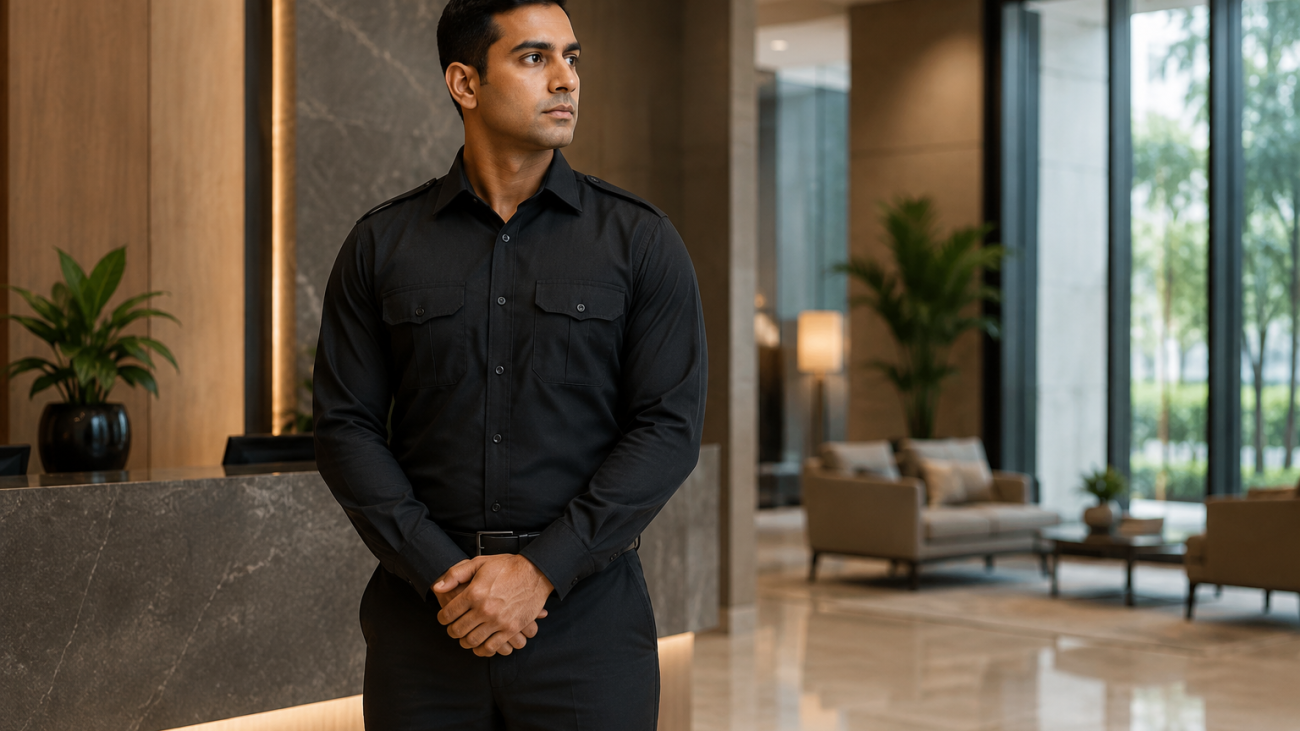
The delivery man states that the house owner had already permitted him to enter the house. The house owner does not answer the telephone call. There are cars forming a line behind him and one more visitor seeking directions, while the passenger is growing increasingly impatient.
Nothing criminal has taken place.
But within the next two minutes, the situation will determine whether it becomes an incident or a security matter.
This kind of ambiguity has to be recognized and managed in public spaces in Malaysia. Malaysia Tourism has recorded 21.2 million foreign visitor arrivals within the first half of 2026, and in 2026, Visit Malaysia showcases more than 300 events across the nation.
Today, with hotels, condominiums, malls, offices, and event venues all receiving strangers, it is essential to be able to deal with them without overlooking any threat or taking any casual disagreement as an attack. This is where an unarmed guard can play an important role in managing routine situations before they become larger security concerns.
Most incidents do not begin dramatically
This aspect of security becomes most visible during a crisis involving robbery, trespassing or assault.
Many different situations arise during a guard’s working day.
Someone enters the premises without a pass. A resident is stalked by another person through an access gate. A customer accidentally enters an employee’s area. An owner refuses to move his/her car from a restricted area.
The first step is to understand the nature of the situation.
The main function of an unarmed but competent guard is to ask basic questions, know all the rules of the site, and not become irritated by the other person’s irritability, embarrassment or anger. An unarmed guard who can communicate clearly can often prevent a routine disagreement from becoming an unnecessary confrontation.
Very often, the situation ends there.
Sometimes, a routine access problem can turn into an altercation, a complaint or something worse.
Communication is part of security training
Such an emphasis on communication does not take away from the importance of professional guarding.
Effective communication is among the academic units of the Certified Security Guard program designed by the Ministry of Home Affairs, the Royal Malaysian Police, and the security services sector in Malaysia. The program also covers Practical 1st Response, 1st Aid, Patrol, Traffic Control and Restricted Areas Control.
As part of its drive to improve the quality of services in the private security sector, KDN has continued mandatory CSG and Trained Nepalese Guard training in 2026.
Training is the foundation. However, the guard still needs to understand how authority operates at that particular location.
The role requires the guard to be able to explain and justify their decisions. This is particularly important for an unarmed guard, whose effectiveness often depends on communication, judgment and knowing when to seek assistance.
The post should define what the guard can decide
Let’s take the delivery/rider case.
Can the guard call the occupant of the house? Can deliveries be held in a designated area? Does the front door remain locked if access cannot be confirmed? What if the tenant can’t be located?
When those rules are not clear, the guard may have to improvise, and a queue can quickly build up.
Businesses deploying an unarmed guard should create straightforward post instructions covering common situations:
- visitor and contractor access;
- deliveries and ride-hailing vehicles;
- restricted areas;
- lost access cards;
- aggressive or intoxicated individuals;
- suspicious activity;
- medical emergencies;
- situations requiring a supervisor or police.
The objective is not to script every conversation. It is to give the guard enough authority to make routine decisions while knowing where that authority ends.
De-escalation does not mean giving in
A calm response may sometimes be mistaken for a poor security response.
Effective de-escalation is not about making the situation worse; it is about applying the rules calmly and consistently. The guard makes the boundary clear, explains the alternative, if any, and repeats it if necessary.
When the behavior is a threat or there is imminent danger, the response will be different. The guard is responding according to the emergency procedure and requesting assistance.
This means that clear escalation procedures are crucial for an unarmed guard. The guard should know who can assist in an emergency, when they can contact the manager, and the conditions that would necessitate emergency assistance.
Cameras cannot conduct the conversation
Access control technology and surveillance can help to reduce some of the ambiguity that surrounds a situation.
For example, a system can show the message “access not authorized” or “access card rejected”. However, it usually cannot determine why it happened or encourage cooperation from the affected individual.
This aspect becomes even more important when considering mixed-use buildings and business facilities where there is more than one authorized user and security threats in the same environment.
Good security depends on both technology to provide information and people to interpret the situation. An unarmed guard remains an important part of that process because technology can provide information, while a trained person can assess the circumstances and respond appropriately.
Hire for the post, not simply the uniform
In determining whether to deploy an unarmed guard, the company must first ask the individual what it is that they will do during their shift.
The role of a silent perimeter guard in a warehouse is distinct from the role of a guard in a condominium which has 100 tenants and many deliveries. A hotel lobby is different, since the guard may need to communicate with and persuade visitors.
Therefore, the company should consider communication skills, training, supervision and induction alongside its basic manpower requirements.
The security industry in Malaysia recognizes that guarding involves communication and first response alongside physical security.
This matters because most of the situations that need to be prevented never become emergencies.
It starts with someone at the door telling you, “I have been told I can enter.”
In many such situations, the value of an unarmed guard is not measured by the use of force. It is measured by the ability to recognize ambiguity, communicate clearly, follow the site’s procedures, and know when a situation needs to be escalated.